The infrastructure for running AI agents while nobody watches has quietly arrived. The biggest agent project on GitHub, a personal assistant built to run around the clock, is closing in on four hundred thousand stars. The runtime I studied for this essay pitches unattended operation even more directly. Close the lid, drop the network, agents keep working, reattach in the morning. The running half of unattended operation is getting built fast. The watching half, what checks the work, prices the run and notices the failure, is not being built at all.
My workspace posts substantive answers into public technical threads, with me approving every one. The posting half had machinery: discovery, drafting, an approval gate. The watching half had none. Replies landed in a notification stream alongside everything else, and for two months no workflow owned reading them. When I built the checker, its first pass surfaced 23 unanswered follow-ups across the threads we'd posted into, including direct questions addressed to me, some sitting since June. Every piece of the posting machinery was working as designed. Unattended operation fails exactly there, in the after, and it fails silently.
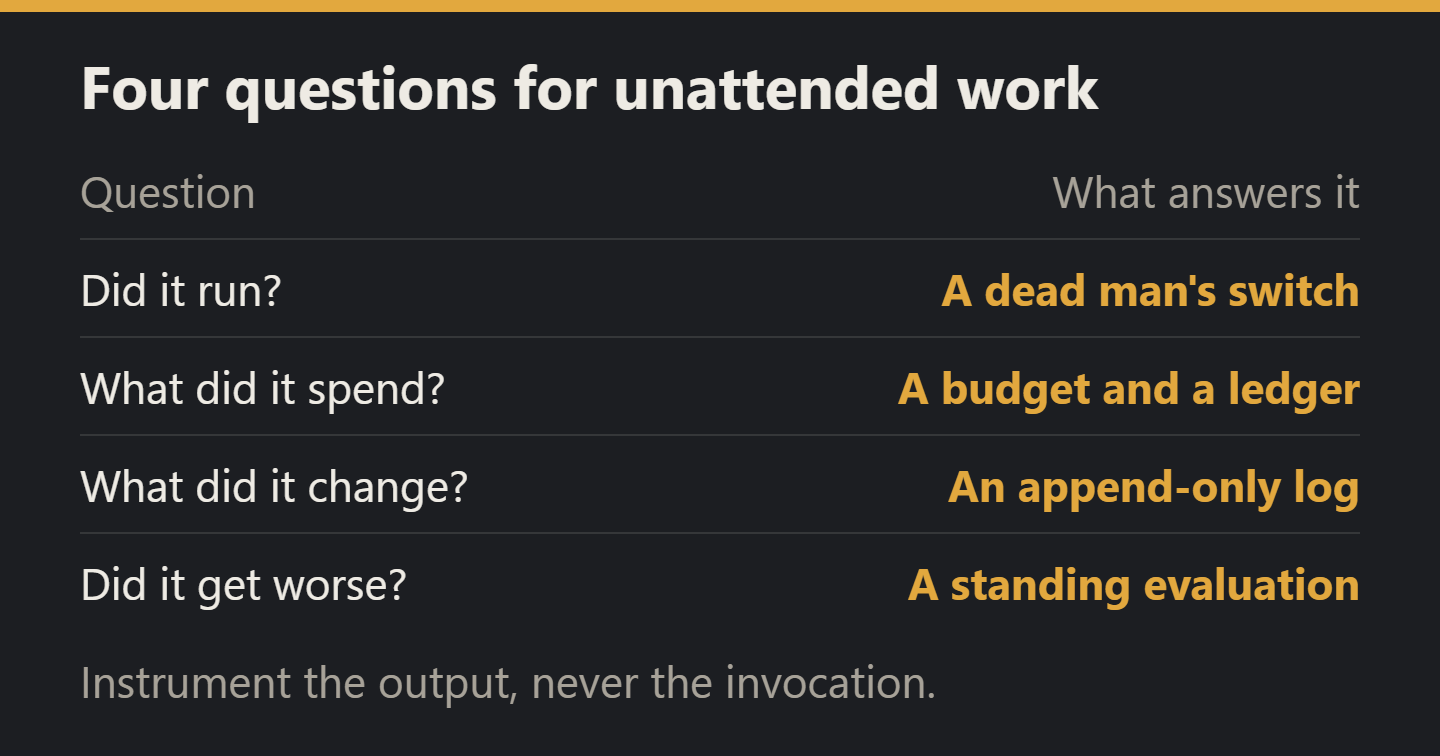
When work runs without a human present, four questions need mechanical answers, because there is no one around to answer them socially.
Did it actually run? Did the thing that should have produced something produce it? A scheduled job that keeps reporting healthy while producing nothing is how you lose a month. The instrument is a dead-man's switch keyed to the artefact the work produces, not to the process that produces it. My rule is to instrument the output, never the invocation. A lane that writes a file proves itself by the file existing, because every prettier signal can lie.
What did it spend? Autonomy multiplies cost invisibly. The public case I keep citing is eleven automated fix rounds, 650,000 tokens re-read per round, every round individually reasonable, the runaway visible only across the whole loop. Budgets belong where the loop lives, sized loose enough that a legitimately heavy run survives them, with a ledger underneath so the trend surfaces before the blowout.
What did it change, on whose instruction? After a detached weekend, "what did the agents do" has to be answerable from a record, not from scrollback. An append-only log of what ran, what it touched, and what triggered it is the difference between an audit and an archaeology dig. It is also how you find out whether something external tried to steer an agent, because instructions that arrived inside fetched content should be findings in a log, not actions in your systems.
Would you know if it got worse? Unattended systems drift. The failure that compounds is not the crash, it's the slow degradation nobody is present for. A small standing evaluation, run on a schedule, replayed several times, turns "I think it's been off lately" into a number with a date on it.
Notice that model quality is absent from that list. The models are the part that mostly works. The four gaps are all workspace architecture, and none of them is exotic. A sentinel, a budget, a ledger, a test suite. The reason they're rare is that they're nobody's feature. Runtimes compete on capability and continuity, because that's what demos. Accountability doesn't demo. The runtime that owns every agent's terminal can tell you a pane is stuck, and cannot tell you what the weekend cost or whether anything checked the work.
So the question for a technical leader isn't whether to allow unattended agent work. Your engineers are already doing it, on their laptops, with whatever discipline they personally carry. The question is whether the four answers above exist anywhere in your organisation, in writing, before the volume arrives. Asking for them now costs a meeting. Reconstructing them after an incident costs the quarter.
I published a teardown of that runtime, and the architecture patterns behind all four instruments, here: the reference architecture. The fix was never smarter agents. It was deciding that someone, or something, owns the after.